Case-based microlearning improves clinical practice
Case-based, spaced, interactive microlearning isn't a trend. It's one of the best-evidenced approaches in medical education.
Clinically reviewed by Dr Toni Hazell, Portfolio GP and trusted educator · Last reviewed: August 2026
The evidence
Proven in randomised controlled trials
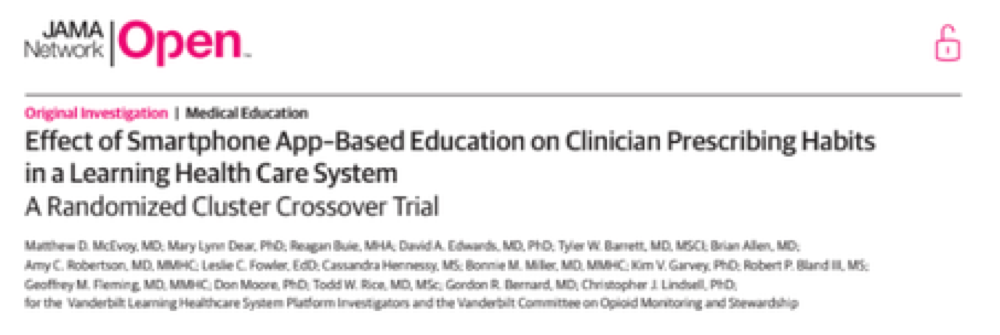
Smartphone app-based education doubles evidence-based prescribing habits in clinicians
354 clinicians · United StatesRandomised cluster crossover trial
McEvoy MD, et al. "Effect of Smartphone App–Based Education on Clinician Prescribing Habits in a Learning Health Care System: A Randomized Cluster Crossover Trial." JAMA Network Open, 2022;5(7):e2223099.
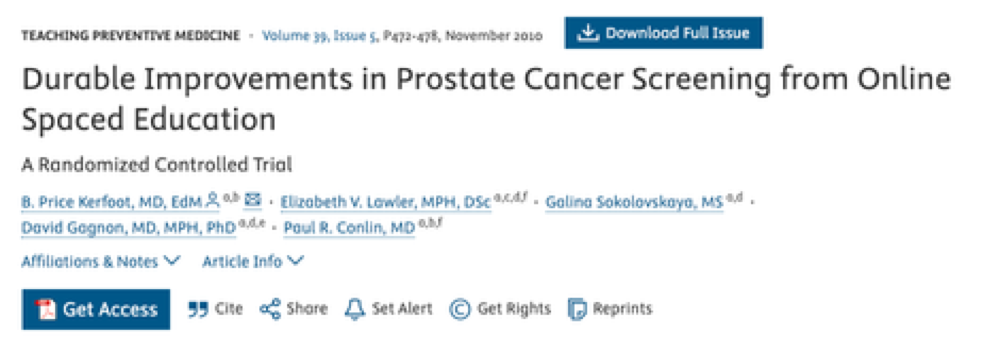
Online spaced education produces durable improvements in prostate cancer screening decisions
95 primary care clinicians · United StatesRandomised controlled trial
Kerfoot BP, Lawler EV, Sokolovskaya G, Gagnon D, Conlin PR. "Durable Improvements in Prostate Cancer Screening from Online Spaced Education: A Randomized Controlled Trial." American Journal of Preventive Medicine, 2010;39(5):472–478.
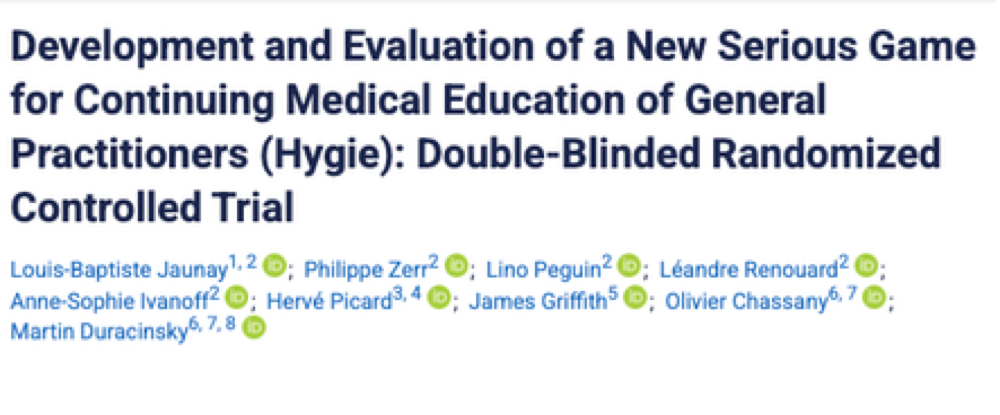
A case-based serious game delivers 75% greater knowledge gain for GPs than reading the same evidence
Jaunay LB, et al. "Development and Evaluation of a New Serious Game for Continuing Medical Education of General Practitioners (Hygie): Double-Blinded Randomized Controlled Trial." Journal of Medical Internet Research, 2019;21(11):e12669.
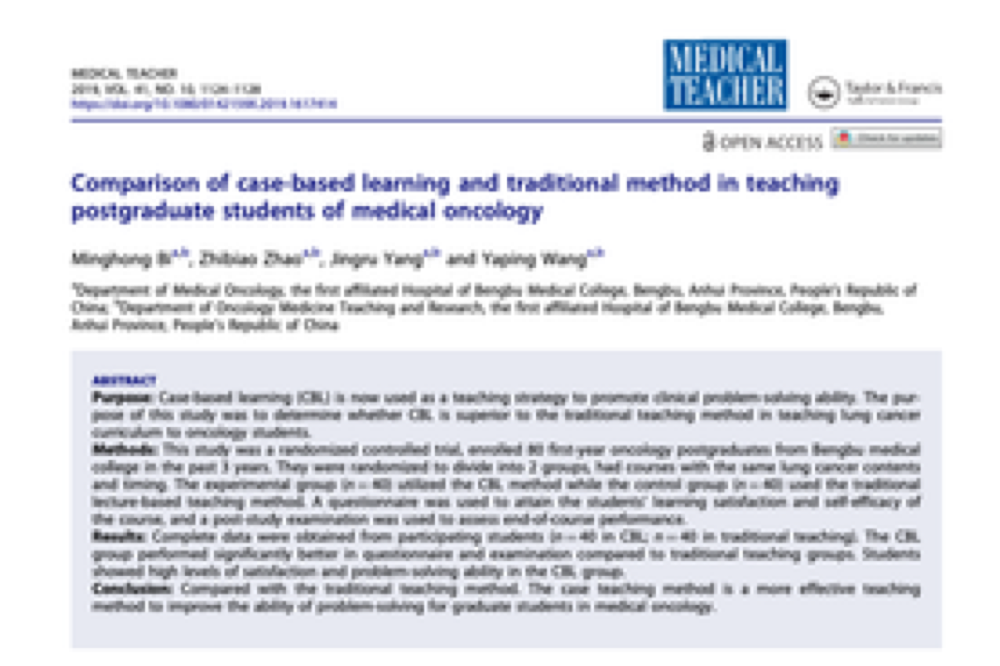
Case-based learning outperforms traditional teaching methods in medical oncology education
Bi M, Zhao Z, Yang J, Wang Y. "Comparison of case-based learning and traditional method in teaching postgraduate students of medical oncology." Medical Teacher, 2019;41(10):1124–1128.
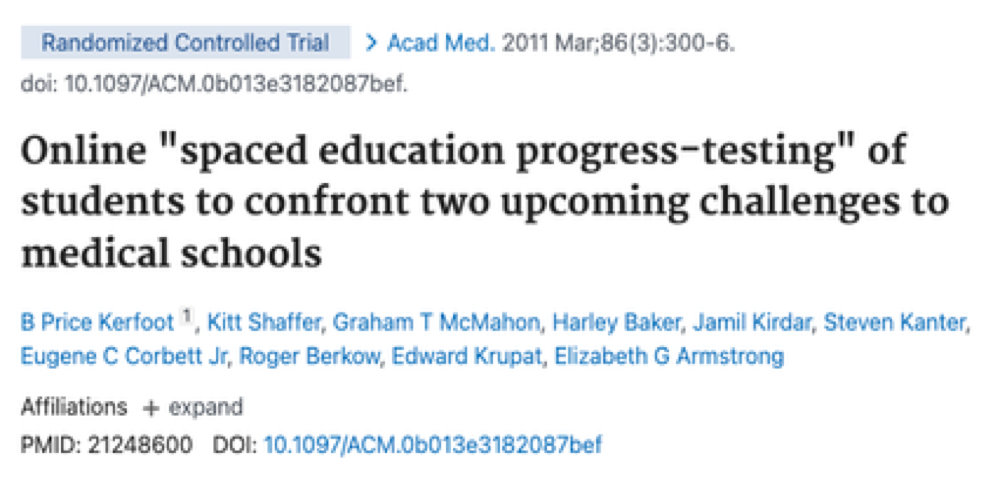
2,648 medical students · United StatesMulti-institutional randomised controlled trial
Kerfoot BP, Shaffer K, McMahon GT, Baker H, et al. "Online 'spaced education progress-testing' of students to confront two upcoming challenges to medical schools." Academic Medicine, 2011;86(3):300–306.
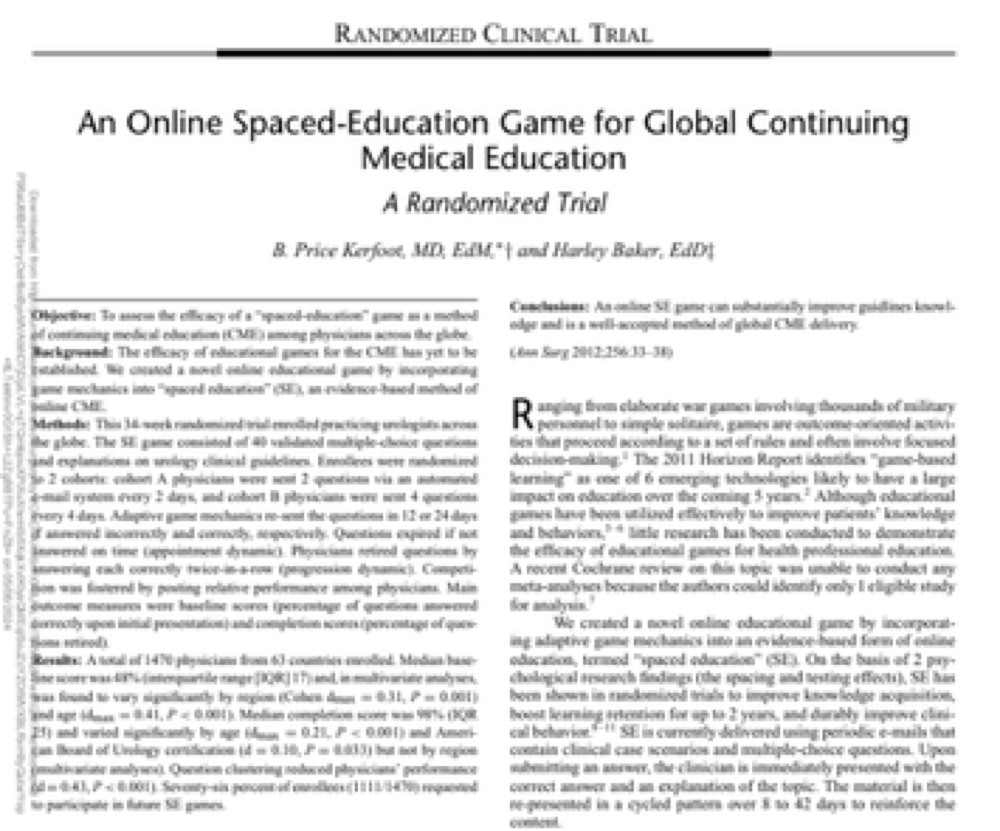
Global microlearning significantly improves clinical guideline knowledge across 63 countries
Kerfoot BP, Baker H. "An Online Spaced-Education Game for Global Continuing Medical Education: A Randomized Trial." Annals of Surgery, 2012;256(1):33–38.
The science
Why case-based microlearning works
Hermann Ebbinghaus first measured the forgetting curve in 1885: without reinforcement, most new information is lost within days. Three mechanisms are proven to counter it, and every study above uses at least one.
Spaced repetition. Short, repeated exposures over time interrupt forgetting and consolidate long-term memory far better than a single sitting.
Active recall. Answering questions strengthens memory more than reading or watching: the testing effect is one of the most replicated findings in learning science.
Case-based context. Clinicians retain knowledge better when it's anchored to a realistic patient decision they recognise from their own practice.
Praktiki modules are built on all three: five-minute, question-led clinical cases, spaced across a programme.
The forgetting curve, and what spaced repetition does to it
Without reinforcementWith spaced repetition
Rate at which medical knowledge doubles
The context
Medical knowledge is expanding faster than any clinician can keep up with
In 1950, medical knowledge doubled every 50 years. By 2020, the doubling time was an estimated 73 days.7 A new research article is published every 26 seconds,8 and 70% of doctors report feeling overwhelmed by the volume of new information.9
The question isn't whether clinicians need continuous learning. It's whether the format fits their day.
Praktiki's results
Praktiki is built on these exact mechanisms: case-based, spaced, interactive
The same mechanisms, measured on Praktiki:
+83
NPS*
85%
completion on cases and quizzes
144,372+
modules completed
1m+
data points from questions answered
Net Promoter Score: doctors
+83
Praktiki
~60
UpToDate
-7
Medscape
Other platform NPS: Health Tech Without Borders Global Health Survey, Clinical Decision Support Tools, Sept 2025, n = 1,014 doctors.
* Internal research, Dec 2025–Jan 2026, n = 850 doctors
FAQ
Common questions about the evidence
Does microlearning actually change clinical behaviour?
Yes. In randomised controlled trials, spaced case-based education doubled evidence-based prescribing among 354 US clinicians (JAMA Network Open), and spaced education improved prostate cancer screening decisions among US primary care clinicians.
What is the forgetting curve?
The measured decline of memory over time without reinforcement, first quantified by Ebbinghaus in 1885. Most new information is lost within days unless it's revisited.
How does case-based learning compare with lectures?
In randomised trials, case-based learning has been associated with better exam results than lectures among oncology postgraduates, and GPs using a case-based game gained 75% more knowledge than those reading the same evidence.
Is five minutes really long enough?
Yes. Short, spaced, question-led sessions are the format the retention evidence supports, and they fit the gaps clinicians actually have. Praktiki sees 85% completion on cases and quizzes.
Where does Praktiki's own data come from?
144,372+ modules completed and 1m+ data points from questions answered on the platform, plus internal NPS research (n = 850 doctors, Dec 2025–Jan 2026).
References
McEvoy MD, Dear ML, Buie R, et al. Effect of Smartphone App–Based Education on Clinician Prescribing Habits in a Learning Health Care System: A Randomized Cluster Crossover Trial. JAMA Netw Open. 2022;5(7):e2223099. doi:10.1001/jamanetworkopen.2022.23099
Kerfoot BP, Lawler EV, Sokolovskaya G, Gagnon D, Conlin PR. Durable Improvements in Prostate Cancer Screening from Online Spaced Education: A Randomized Controlled Trial. Am J Prev Med. 2010;39(5):472–478.
Jaunay LB, Zerr P, Peguin L, Renouard L, Ivanoff AS, Picard H, Griffith J, Chassany O, Duracinsky M. Development and Evaluation of a New Serious Game for Continuing Medical Education of General Practitioners (Hygie): Double-Blinded Randomized Controlled Trial. J Med Internet Res. 2019;21(11):e12669.
Bi M, Zhao Z, Yang J, Wang Y. Comparison of case-based learning and traditional method in teaching postgraduate students of medical oncology. Med Teach. 2019;41(10):1124–1128. doi:10.1080/0142159X.2019.1617414
Kerfoot BP, Shaffer K, McMahon GT, Baker H, Kirdar J, Kanter SL, Corbett EC Jr, Berkow R, Krupat E, Armstrong EG. Online "spaced education progress-testing" of students to confront two upcoming challenges to medical schools. Acad Med. 2011;86(3):300–306. doi:10.1097/ACM.0b013e3182087bef
Kerfoot BP, Baker H. An Online Spaced-Education Game for Global Continuing Medical Education: A Randomized Trial. Ann Surg. 2012;256(1):33–38. doi:10.1097/SLA.0b013e31825b3912
Densen P. Challenges and opportunities facing medical education. Trans Am Clin Climatol Assoc. 2011;122:48–58.
Proliferation of Scientific Medical Journals: A Burden or A Blessing. Oman Med J. 2010.
Physician Learning Preferences. A Doximity Report. 2022.